Where cards come from, which colors you can actually get, and what transmuting really does.
The one thing to understand
There is no single answer to “which colors can my class get”. The game checks three different ways depending on where the card is coming from, and they don't agree with each other.
Three banners are two-color: Aqua is Green and Blue, Orange is Green and Red, Purple is Blue and Red. Those are the only ones the three checks disagree about:
| Where the card comes from | To get a two-color banner you need… |
|---|---|
| Rewards after a battle | Both of its colors |
| The shop | Just one of its colors |
| Transmuting, shrines and events | Just one of its colors |
| Sidemuting | Nothing — color is never checked |
So a Rogue, who starts with Green and nothing else, is never offered an Aqua card after a battle — it only has half of what Aqua needs. The shop will happily sell one, though, and from then on it transmutes and upgrades like any other card.
Colors and rarities
A card's banner color is what it costs to play. That's all it means:
- Costs DEX and INT? Aqua. DEX and STR? Orange. INT and STR? Purple.
- Costs just one? Green for DEX, Blue for INT, Red for STR, Gold for Holy.
- Costs health or is a Corruption card? Black — it isn't only about blood cost.
- Costs none of the above? Brown, which everyone can always use.
Transmuting moves a card one step up this ladder. Monster sits below Common, which is why a monster card becoming a Common is an ordinary upgrade rather than the oddity it looks like:
Legendary has nowhere higher to go, so it stays Legendary. That's why transmuting a Legendary behaves like a sidemute that keeps its color — and it's the trick for “sidemuting” a Legendary black card, which normally can't be done.
What each class can reach
Starting attributes only. Anything you pick up later — a talent, a Locket, a Surge — adds to this straight away.
| Class | Starting attributes | Combat rewardsRewards | ShopShop | Transmute, shrines & eventsTransmute |
|---|---|---|---|---|
| Arcanist INT | INT | |||
| Hunter DEX + STR | DEX + STR | |||
| Knight INT + STR | INT + STR | |||
| Rogue DEX | DEX | |||
| Seeker DEX + INT | DEX + INT | |||
| Warrior STR | STR |
Every row lists its colors in the key's order. Gold is in the key but in none of the rows — it needs Holy access, which no class starts with. Sidemuting has no column here because it never checks color at all.
Rewards after a battle
- Color: each slot has a 45% chance of being forced to your own class color — 65% inside Sunforge. With Holy access there's also a 15% chance of Gold. Otherwise it's anything you can reach.
- Holy: without Holy access, cards costing Holy are removed on top of everything else. That's why a handful of Warrior and Rogue cards feel unreachable — they cost Holy despite wearing a class color.
- Rarity is a roll weighted by your luck: more luck widens the Legendary, Rare and Uncommon bands and shrinks Common. Bosses add a large bonus to Rare and Uncommon — but not Legendary.
- Restrictions are best-effort. When something promises “a Rare card” or “a Green card”, the game applies those limits one at a time and abandons any limit that would leave nothing to offer. You get a card that breaks the promise rather than no card at all.
The shop
The shop is the most generous of the four, and usually your only way into a color your class can't be offered.
- Black is never sold. Not rare — never.
- Each slot rolls the same 45% chance of your class color as battle rewards.
- Conjured cards are excluded, and companion cards unless you're a Hunter with a companion.
- Cards that cost nothing at all skip the color check completely, which is how the odd off-color card turns up in stock.
Transmuting one rarity up, same color
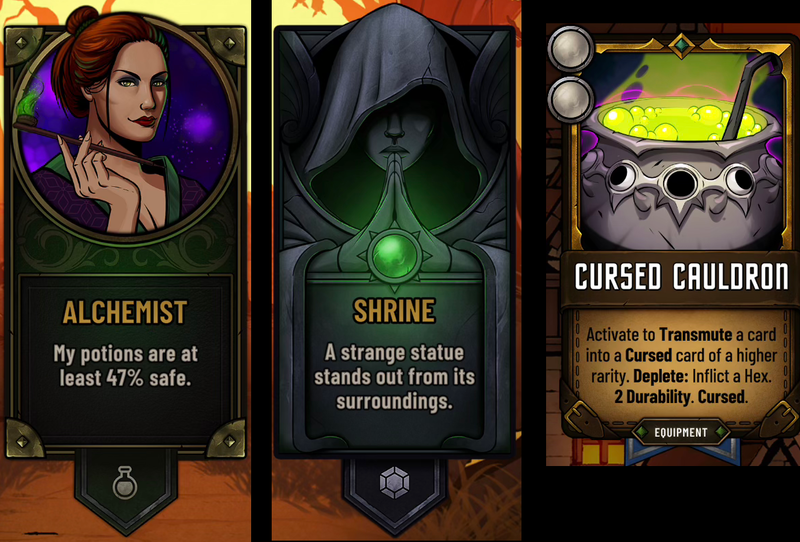
Your options are chosen like this:
- Start from every card that can be obtained at all, plus every potion
- Keep the ones one rarity higher that you're able to cast
- Keep only your card's own color
- Throw out the card itself, and any Unique you already own
- Pick from what's left completely at random — nothing is weighted
If step 3 leaves nothing, the game starts over and skips the color step. You still get the rarity upgrade, just in some other color you can use, picked at random. That's the “random mess of cards” people report after transmuting a color they can't cast — it isn't a bug, and it's never a downgrade.
Sidemuting same rarity, same color
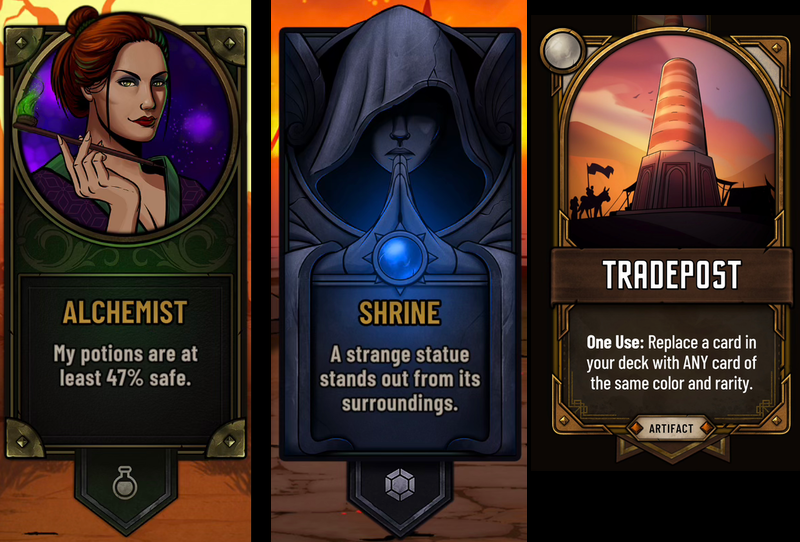
| Sidemuting a… | Gives you |
|---|---|
| Black card | A Brown card — black is swapped for brown before anything else happens |
| Monster card | Another monster card, at any rarity — rarity isn't matched here |
| Anything else | The same color and rarity — your class never matters |
When there aren't enough real options, the spare slots are filled with potions of the same rarity. That's the random junk you may have noticed in the extra slots.
You get 3 to 6 options, depending on your card sets.
Opening up new colors mid-run
Two ways, and they don't do the same thing.
Gaining an attribute
This is the only thing that changes what battle rewards will offer you.
| Talent | Tier | Effect |
|---|---|---|
| Greater Dexterity | 3 | +1 dexterity |
| Greater Intellect | 3 | +1 intellect |
| Greater Strength | 3 | +1 strength |
| Apotheosis | 6 | Drops all three to zero — every class color leaves your rewards for the rest of the run |
A single point of intellect is what turns a Rogue's battle rewards from Green-only into Green and Aqua. Nothing in the game tells you this has happened.
Cards that grant access directly
| Card or talent | What it is | Opens up |
|---|---|---|
| Rogue's Locket | Uncommon card | DEX cards |
| Arcanist's Locket | Uncommon card | INT cards |
| Warrior's Locket | Uncommon card | STR cards |
| Divine Focus | Legendary card | Holy cards |
| Gift of Nature | Legendary card | Monster cards in rewards |
| Offer of Emulation | Talent, tier 6 | Monster cards in rewards |
These work only while the card is in your deck — remove it and the access goes with it. Nothing in the game grants a two-color banner directly — you always have to pick up both of its colors separately.
Card sets you switched off
The sets you enable when you start a run decide the pool for that whole run. Turn one off and its cards are gone from everything — battle rewards, the shop, transmutes, sidemutes, shrines and events alike. Talents work the same way.
It costs you twice: the pool shrinks, and so does the number of options a transmute or sidemute offers, which is tied to how many sets you left on.
Some things arrive anyway:
- A card an event hands you by name — it is fetched by name, not drawn from your pool, so a story reward turns up whatever you enabled.
- Monster cards, including sidemuting one and the monster cards Gift of Nature or Offer of Emulation let into your rewards.
- Companion cards, if you are a Hunter with a companion.
- Adaptations, and the odd special category like junk or treasure cards, which are pulled by keyword rather than from the run pool.
Cards you can never get
Some cards are simply marked unobtainable, and no amount of transmuting, shopping or rerolling will produce them. Of the 2,769 cards in the game, 962 can never be given to you.
That covers everything the community lists — basic attacks, arrows, bombs, ingredients, story cards, revelations, companion cards, transformed cards — and plenty more besides. Cards can also be barred from Sunforge specifically, or from being conjured, without being unobtainable everywhere.
How the number at the end of a run is put together, and which parts of it get multiplied.
The order it is built in
Order is the whole story here. Anything counted before a multiplier gets multiplied by it; anything added after does not.
- Bosses you killed, worth more on higher difficulty.
- Objectives you met, each adding its own points.
- Malignancy raises that whole total by a percentage.
- Story Mode halves it. No other difficulty changes it here.
That is your score. Experience carries on from it: a daily run doubles the score, and Spine damage is added last.
Spine damage is worth exactly the damage you dealt, and because it lands after everything else, no multiplier ever touches it. It also does not appear in your score at all — only in experience.
Bosses
Every boss is worth the same amount, decided by the difficulty you are on:
| Difficulty | Points per boss |
|---|---|
| Story Mode | 100 |
| Normal | 100 |
| Challenging | 200 |
| Hard | 500 |
| Impossible | 750 |
Sunforge ignores that table and pays by how deep you are instead. The first nine bosses pay the Normal rate, the next eight the Challenging rate, the eight after that the Hard rate, and everything from the twenty-sixth boss on pays the Impossible rate.
Malignancy
Each malignancy adds 5% per tier, and they stack. Three tier-3 malignancies is 45% on top of everything counted so far — which is why the export prints one percentage for the lot.
In Sunforge this slot works differently: the bonus comes from rerolls you did not spend, and you get none of it unless you killed seven bosses.
Runs that score nothing
A run shorter than three minutes scores zero, however well it went.
Fateshards
Fateshards come from experience, not score: one per 100, times a multiplier that gets smaller as difficulty rises.
| Difficulty | Fateshard multiplier |
|---|---|
| Story Mode | ×1 |
| Normal | ×2 |
| Challenging | ×2 |
| Hard | ×1.5 |
| Impossible | ×1.25 |
Harder runs still earn far more, because the experience they produce grows much faster than the multiplier shrinks. Sunforge always uses ×1.
Offer of Progress doubles your Fateshards if you win, and leaves you with none if you lose. It does nothing in Sunforge.
One piece is missing: the list of individual objectives and what each is worth lives in the game's data rather than its code, and has not been read out yet. The order and the multipliers above are exact.
An act is an area, and what it holds is fixed before you set foot in it.
Nothing here is random
Every area deals out a set number of battles, opportunities, campfires, NPCs and shrines. The order you meet them in is shuffled; how many there are is not. Three things change the counts:
- Difficulty removes campfires, and only campfires. You get one fewer for each step above Normal — so a three-campfire area gives you three on Normal, two on Challenging, one on Hard and none on Impossible.
- Talents can add to any of the five — but only where the area already has at least one. A talent granting an extra NPC does nothing in an act 1 area, because act 1 has no NPCs at all.
- An invasion trades one opportunity for up to two of its own events.
Every act
Counts before difficulty and talents are applied. Areas at the same act number are the alternatives you pick between.
| Act | Area | Enemies | Opportunities | Campfires | Npcs | Shrines | Total |
|---|---|---|---|---|---|---|---|
| 1 | A Dark Dream | 5 | — | — | — | 1 | 6 |
| 1 | Heroes' Rest Cemetery | 1 | 4 | 3 | — | 1 | 9 |
| 1 | Sunfall Meadows | 3 | 3 | 3 | — | 1 | 10 |
| 1 | Weeping Woods | 3 | 4 | 3 | — | 1 | 11 |
| 3 | Eastern Blightwoods | 6 | 5 | 3 | 2 | 2 | 18 |
| 3 | Grove of the<br>Dying Star | 4 | 4 | 3 | 2 | 2 | 15 |
| 3 | The Vesparin Mansion | 1 | 3 | — | — | 2 | 6 |
| 5 | Emberwyld Heights | 6 | 5 | 3 | 3 | 2 | 19 |
| 5 | Noxlight Swamp | 7 | 5 | 3 | 3 | 2 | 20 |
| 5 | Riphide Ramparts | 5 | 4 | 3 | 3 | 2 | 17 |
| 6 | Temple of the Pyre | 3 | 5 | 3 | 4 | 2 | 17 |
| 6 | The Ambermines | 4 | 5 | 3 | 4 | 2 | 18 |
| 6 | The Isle of Talos | 4 | 4 | 2 | 5 | 2 | 17 |
| 6 | Vault of the Lightless | 4 | 4 | 3 | 5 | 3 | 19 |
| 7 | The Deep | 6 | 4 | 2 | 5 | 2 | 19 |
| 7 | The Dreamwell | 5 | 4 | 3 | 5 | 3 | 20 |
| 7 | The Godscar Wastes | 6 | 4 | 2 | 5 | 2 | 19 |
| 7 | Thornwind Pass | 6 | 4 | 2 | 4 | 2 | 18 |
| 8 | Obsidian Garden | 4 | 4 | 2 | 3 | 2 | 15 |
| 8 | The Halls of <br>Silent Saints | 3 | 4 | 2 | 3 | 2 | 14 |
| 8 | The Onyx Cathedral | 4 | 5 | 2 | 3 | 2 | 16 |
Brightcandle and the act 9–10 areas are left out: they carry no counts at all, because their content is scripted rather than dealt.
These rules come from the game's own logic rather than from testing, so the edge cases are exact — but the community worked them out first. Thanks to Joel on the Dawncaster Discord, whose transmuting guide every page here was checked against, and whose dawn-dash supplies the event decision trees. Icons by Lucide (ISC).